My obsession with Victorian mediums
My current book is set in 1873 London and tells the story of two warring spirit mediums: one an older, established, leading Medium who’s become reliant on her income to survive, the other a talented young upstart drawn to the world by the promise of fame. While it’s inspired (rather than based) on a true story, I’d been looking for something around Mediums for a while.
I find Mediums absolutely fascinating – is it real? I know it can’t … but can it?
When the new religion, Spiritualism, arrived in England in the 1850s after its foundations were set by the Fox sisters in the US, it became incredibly important in the lives of women, regardless of class: not only was mediumship one of the only respectable ways in which a woman could generate her own income, it also facilitated social mobility and engendered sisterships at a time when single women were seen as burdens on society.
My interest isn’t all philanthropy, though: I’m also fascinated by the deception. Spiritual Circles were groups of Mediums – public and private – who would come together regularly for seances and, through their shared interest, great friendships were inevitably formed. Some of those Mediums would be totally honest and believe whatever they were saying, while others – of course – were not. Let’s be honest, if someone’s being bounced around the ceiling, it’s unlikely it’s being done by the hands of a spirit, no matter how earnestly you say that it is. So how did a fraudulent Medium sit with their friends and make up such massive lies? How did that even work?
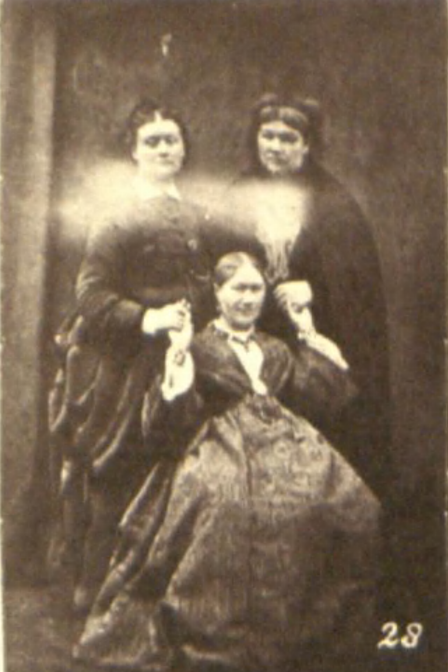
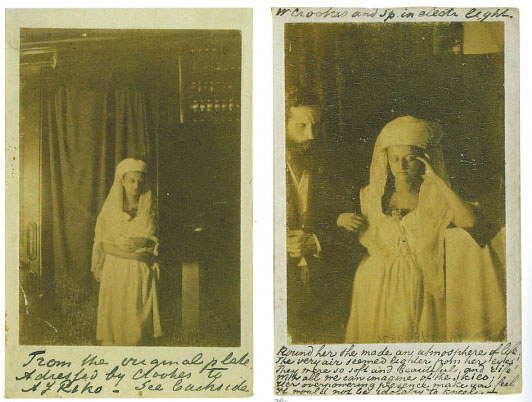
Take Agnes Guppy’s Circle, for example, who all shared mutual respect for one another and great respect, as is clear in Georgiana Houghton’s diaries published as ‘Evenings at Home in Spiritual Seance’. Georgiana was a spirit painter and private Medium*, brought to spiritualism after the loss of her beloved sister. While most of the Circle (including Georgiana and Mrs Tebb – as seen in the photo on the left) appear to have been producing modest trancework and visions, Agnes was regularly hoisted about by spirits and delivered hundreds of apports from the Other Side. She once gifted her fellow Circle-member and famed spirit painter, Georgiana Houghton, a dove from the spirits, which she adored and had with her for years, and then paid for it to be stuffed when it died. And there was a time she was clearly having a bit of fun when she told Georgiana that her mother wanted her to make a coat of many colours, and so that’s what she did and she wore it at every seance afterwards.
And yet, they all considered themselves great friends.
How did Agnes hoodwink her friends for so long and still live with herself? Strangers I can get, but friends?
It’s such a strange dynamic and I really wanted to explore it in my book. I can only imagine that Agnes made her peace because she believed that the work she did helped people – not the showstopping stuff, but the quieter, private work she offered. That’s certainly what my Agnes-based protagonist, Mrs Wood, does. She knows that for all the stunts she performs, she’s in a unique position to help those in grief and pain. It’s why she struggles in her relationship with the young Medium she takes under her wing to train, Miss Bird, who’s based loosely on the Medium Florence Cook. I have Miss Bird driven by her childhood in poverty to acquire things and people of note for herself. She doesn’t use her gift to help people, she uses it for her own advantage. That’s their conflict.
Ultimately, though, I’m also really drawn to the idea of spirits. I’ll watch or read anything about ghosts or poltergeists because there’s a part of me that thinks it’s real. And even after copious drafts, loads of research and reading memoirs by psychics and Mediums exposing their own secrets, I still think it might be.
* A private medium would only work at home with friends, there was no commerce involved at all. Public mediums, such as Agnes, earned an income from stipends, gifts and tokens.