Doin’ it the American way
OR, HOW DOES THE SUBMISSION PROCESS WORK FOR UK AUTHORS IN THE US?
I googled the arse out of this when my UK agent suggested a US agent might want to take my book out in the US. Was the process the same? Was it quicker? Was it – GOD FORBID – slower?? Would I finally get my pre-empt?
It turned out to be all of those things, so if you’re wondering this very question now, here’s how it worked for me. Obviously, this may not be what others have lived but … it’s all I have.
US REPRESENTATION OF UK REP’D AUTHOR
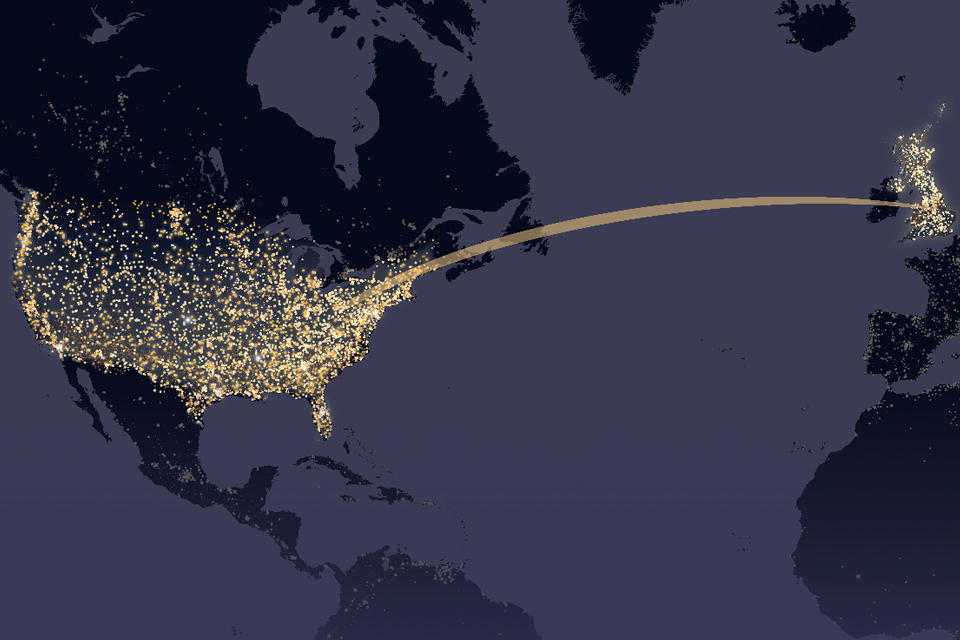
For a UK author, there are two ways to get a publishing deal in the US: lots of people I know have sold World Rights for their novels which includes the US, or their UK Agent uses a US partner agency who’re based in the US. It was the latter process for me.
After talking with her during London Book Fair, Lucy, my UK agent, submitted my MS to her partner US Agent, Andrianna, just before we made the final tiny submission edits to see if she wanted to take it out to the US market.
I was absolutely shitting it while Andrianna read it – it was the first time someone outside of Lucy and my closed circle had read it. Thankfully, after an excruciating week, she came back and said that she was up for it.
NEXT STEPS
EDITORIAL: Lucy had sent Andrianna the penultimate MS – she had a few tweaks she wanted made, but she suggested we hold on these until A came back, in case she had had more feedback, or if it differed. Also, I think, just in case she hated it. Obvs.
Fortunately, A didn’t have any additional feedback on edits, so I just had to make the final tweaks Lucy wanted and, between them, they decided when they wanted to send the MS out to Editors.
SUBMITTING TO US PUBLISHERS:
Mrs Wood could’ve been submitted in the US in a number of ways:
- Go out at the same time as the UK – this is a more confident move.
- Go out when offers are being made in the UK – this could work better as US editors buying UK books would be motivated by seeing movement in the UK market.
- Go out when a deal has been agreed/announced. Obvious reasons.
Together, Lucy and A opted for 1-ish – it went out a few days after the UK but before there had been any movement in the UK. I had no input on this, this was purely down to their experience and gut.
OFFERS FROM THE US
As predicted, there wasn’t any noise from the US editors until some UK editors had thrown their hats into the ring. The day the UK deal was struck (only struck, not publicised), my US Agent let those who still had Mrs Wood know and the day after, I had my first expression of interest from a US publisher. Then, a few days later, another one.
This is the part in the process where I found the biggest difference:
- In the UK, publishers throw their hats in the ring with a financial offer. This could be a preempt, but is mostly a first offer. Pitches from the publishers follow this to see if you’re a match, and then you’ll get your final offer. This is especially the case when there are several publishers in the running (that’s an auction).
- In the US, publishers flag an expression of interest. This is then followed by a pitch from the publisher to the author. It’s only after that that an offer is put on the table. Obviously, it’s a good sign if an editor wants to meet you but you don’t know for sure if someone’s going to offer anything until after that pitch.
I had two requests for meetings come in that week. Which was super exciting, obvs. But also hugely nervewracking – what if they met me and thought I was a dick and didn’t want to progress? I have a real habit of jibbering when I’m nervous, and a desperate need to make people laugh when I’m uncomfortable. Neither of which are especially professional, or vibe very well with the much more straight-laced Americans I’ve worked with before.
Fortunately, the editors were just brilliant and I didn’t flash a boob or say anything with a punchline so both meetings went well.
A few days later the first offer came in, then, late on Friday night which had become increasingly …. bubbly, the second offer came in. It got to the point that night when my husband had to respond to emails because I had horrendous Prosecco Thumbs.
It definitely felt as though the publisher held the cards more in the US than in the UK. Everyone I met was incredibly warm and generous, but the talk felt a bit more hardball and less negotiable. In the UK I received twenty page documents with publishing plans and lists of quotes following the Publisher Pitches. In the US it was much more: this is our offer, this is why we’re right to publish you. It was much more subdued, a lot more business.
The decision of who to go with was as tough as it was with the UK – they were very different publishers but both had their own, unique qualities and even though I’m really happy with my decision, I was still gutted not to be working with the publisher I turned down.
BUT DID I GET MY US PRE-EMPT?
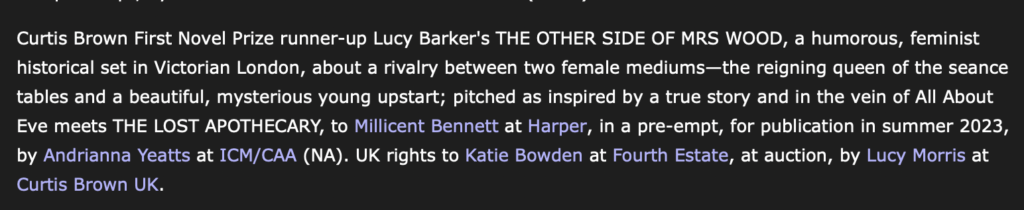
Interestingly, in the Publisher’s Weekly announcement, the deal was called a pre-empt. I didn’t realise that it was, but I guess they offered and I took it off the table, so maybe I did get my pre-empt after all.