
Location, Location, Location!
My protagonist lives and works in 1873 Notting Hill. The amount of time I spent trying to find the right place for her was SO much fun, but also VAST. Because one of the things I love about historical novels, or actually any kind of novel, is when it’s set somewhere I know. Being a London history geek, I especially love if it’s London. And I especially hate if it’s not quite right.
If you’re using real places there are two things you absolutely have to check: that the place exists and if it does, that your character would actually live there. You may love Limehouse, but would the daughter of an MP move there with her insurance agent husband? Or did the Lewisham villa your murderous octagenarian took shelter in even exist in 1864? These may seem like small potatoes when it comes to the bigger pieces of your – all important – plot, but, trust me, SOMEONE OUT THERE WILL KNOW if you’re wrong, and do you really want that person writing your Amazon review?
So how do you avoid these issues? Reeeeeeesearch.
DOES YOUR LOCATION EXIST?
My protagonist, Mrs Wood, lives at 27 Chepstow Villas. This is a road lined with quintessentially London white-stucco houses that runs between Portobello Road and Westbourne Grove, both well-known streets in even more famous Notting Hill. I wanted to write about this part of London because I know it really well – I lived in various places in the area for years, including on Portobello Road, and still visit friends there regularly. It’s a place steeped in history and character, drawing people from all kinds of worlds so it felt right for a Medium with a wide reach to live there too.
But knowing a place in the 21st Century was actually not especially helpful when it came to understanding the neighbourhood in the 1800s. For ages Mrs Wood lived on Cambridge Gardens which is a street of elegant Victorian townhouses. It seemed the perfect place for her to host respectable seances and sup her sherries. But, actually, when I got round to checking, I discovered that Cambridge Gardens didn’t exist in 1873.
I had assumed the whole of Notting Hill, being huge white villas, rambling terraces and tall townhouses, had to have been built by the mid-1800s. I was wrong. Cambridge Gardens, which runs behind what-is-now Ladbroke Grove station but was, at that time, rather confusingly, Notting Hill Station (Notting Hill Gate just up the road also has a tube station), wasn’t there until the 1880s. In fact, everything north of the railway line was fields and farmland until then. You cannot fudge fact, because, as I’ve said before: SOMEONE WILL KNOW. And so I moved her.
To find out if your chosen address actually existed during the period you’re writing, turn to British History Online.
British History Online is a collection of nearly 1300 volumes of primary and secondary content relating to British and Irish history, and histories of empire and the British world. BHO also provides access to 40,000 images and 10,000 tiles of historic maps of the British Isles.BHO website
I genuinely couldn’t have written my book without this website. It helped me to figure out which parts of Notting Hill, Kensal Rise and Westbourne Green had been built and when, so I could somewhere that actually existed for Mrs Wood to move into, as well as all my other characters who also needed homing.
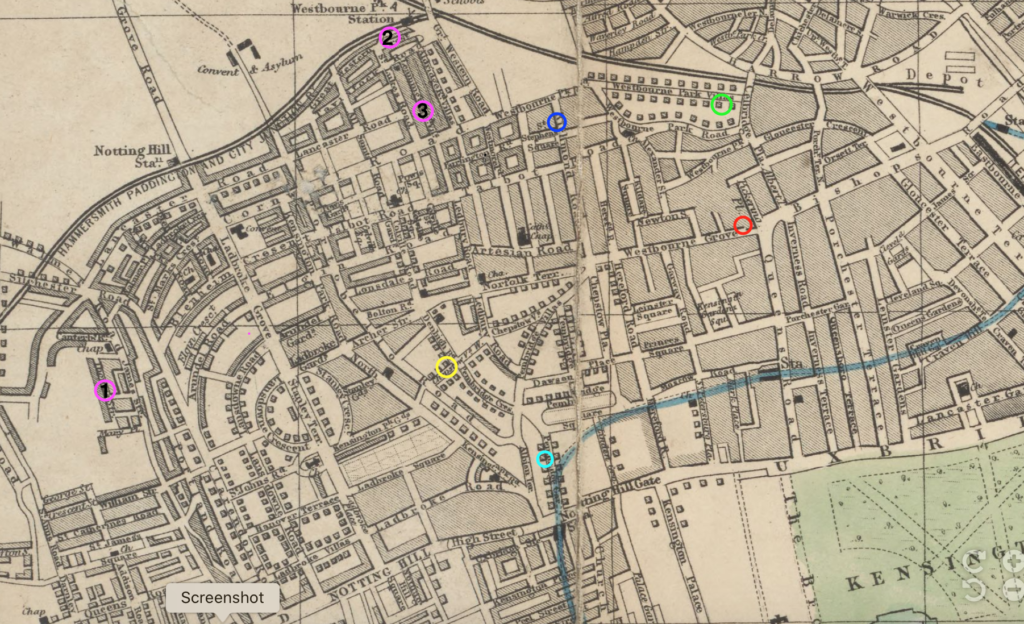
For cross-checking I used/nerded out with The Village London Atlas: Changing Face of Greater London, 1822-1903 and the A-Z of Victorian London, which is an atlas of 1888 London – again slightly later than I needed but still really useful for quick references on things like place names, main routes and churches (which were usually in place before housing developments). Digitally, Old Maps Online is an absolutely indispensable resource for original and searchable maps from the past few centuries, for the UK and beyond. This was where I was able to check what was built when in Notting Hill – Philip’s new plan of London is on there. And its publication date? 1873. DING!
So: this is how Notting Hill looked in 1873, when my characters ‘lived’ there, with their homes plotted out. Mrs Wood is yellow at 27 Chepstow Villas with the three addresses of Miss Bird in magenta. The other characters are from Mrs Wood’s Circle: Mr Larson (Neon Green); Miss Brigham (Blue); the Adams Sisters (Red); Mr & Mrs Reynolds (Turquoise).
WOULD YOUR CHARACTER LIVE THERE?
You know your location existed, but is this a street that would actually suit them? If they’re market traders have you moved them in next to a Lord? If he’s a Lord is he living beside an artificial flower maker? Those are fairly obvious distinctions, but it can get quite nuanced: a captain living beside a banker? Would a shipping clerk live next to a railway porter?
Mrs Wood is well-to-do, but I didn’t want to make her upper class, or have her living in that environment. She wouldn’t, and it would put too much pressure on her after becoming a widow (no spoilers, he’s popped his clogs a few years before the book starts). Likewise, I don’t want Miss Bird to be living in abject poverty at the start, but it was also important that she was living somewhere a bit dodgy.
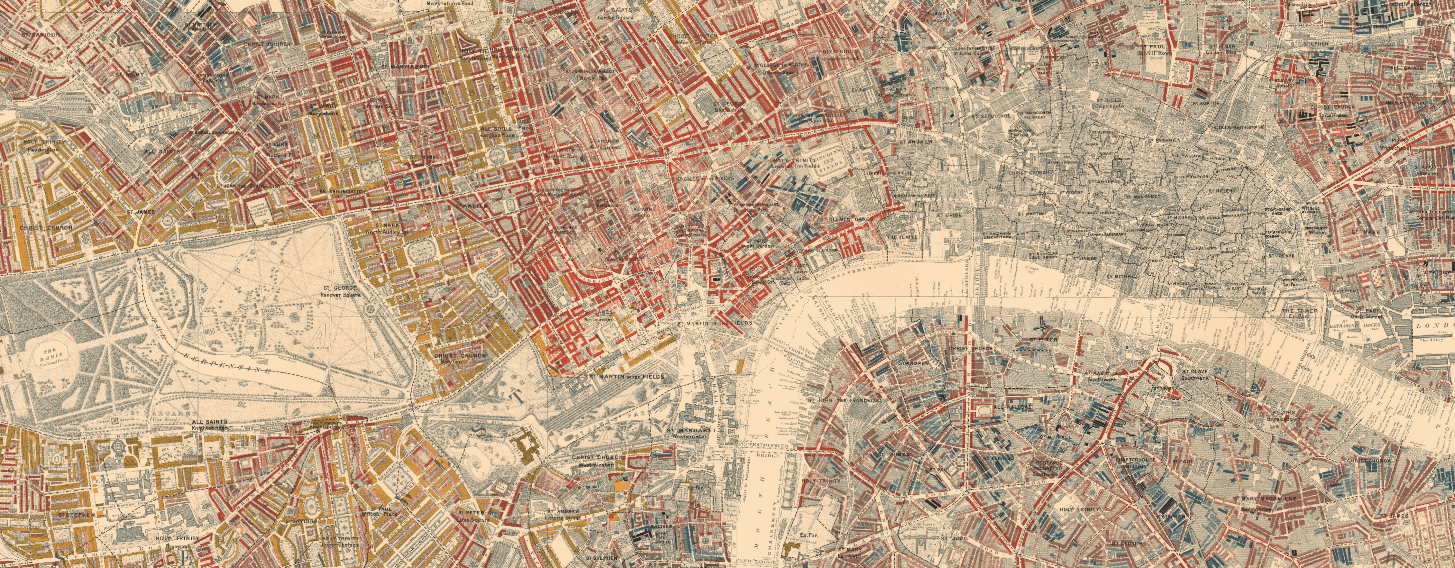
For me, when I’m writing about 19th Century London, Charles Booth’s London Poverty Maps are an absolute gamechanger for making sure that the area suits the character. British History Online can tell me that Notting Hill was a new area that was cheaper than central London, but attracted well-to-do families looking for bigger homes and a quieter life. So that told me which streets were available to me. It was Booth’s maps, while still a little later that my period, that then told me which streets from those available would suit Mrs Wood best.
I have to say, that I look at Booth’s London Poverty Maps even when I’m not researching anything. I was given the book a few Christmas’s ago and it’s absolutely brilliant. Like disappear-down-a-wormhole-to-the-past brilliant. I’ve seen the originals in the British Library too and it was almost as exciting as when I saw Bros in 1988.
Charles Booth’s Inquiry into the Life and Labour of the People in London, undertaken between 1886 and 1903, was one of several surveys of working class life carried out in the 19th century. It is the only survey for which the original notes and data have survived and therefore provides a unique insight into the development of the philosophy and methodology of social investigation in the United Kingdom.LSE Booth Archive
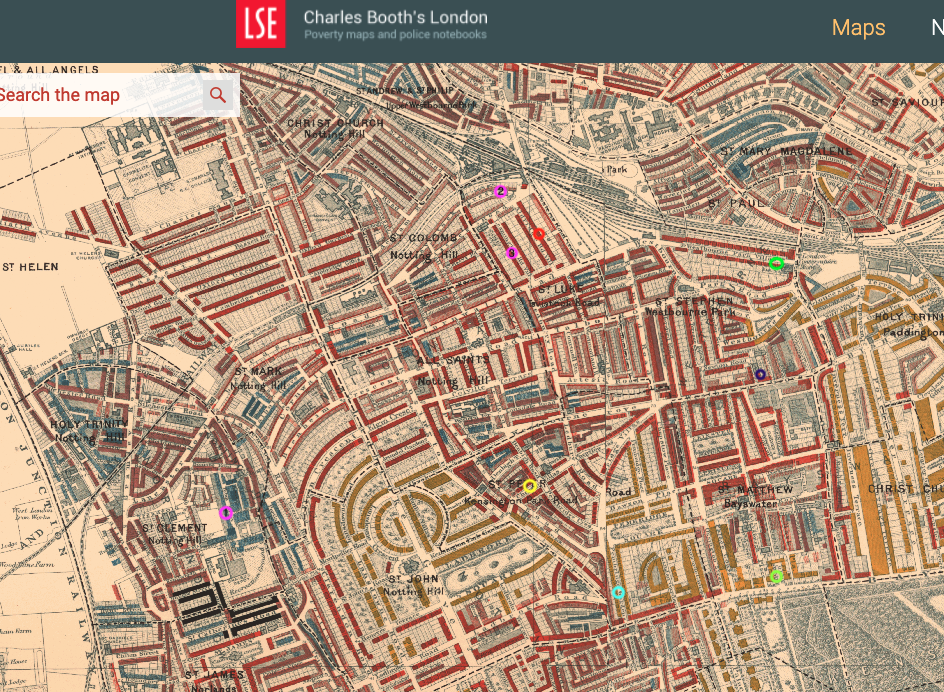
Honestly, if you’ve a spare day, have a noodle around and discover the best social documentation of London available for the late 19th Century. It’s not just maps available online, but the accompanying notebooks are fascinating too. While they’re a little later than my period, as I say, they still give an indication of who lived where. So for my wealthy patrons, I popped them into the Gold/Upper Class houses of Kensington and Mayfair, with smatterings up in Hampstead. For everyone else, I found places in the Red/Well To Do streets. Except Miss Bird, who starts out in a quarter near the recreation ground and Latimer Road which was, while bordered by Pink/Red was Blue/Black – very poor or criminal. She then moves to a Pink street – which is mixed – some comfortable, some not – and then to Leamington Road Villas which is Red. Every decision I made at this point, though, needed cross-checking with the Phillips map to ensure that the houses I chose actually existed in 1873. Time consuming, yes. SUCH a good waste of time, yes.
The result is below. You can see that there’s been a huge amount of development between 1873 and 1886 above Notting Hill station, right up to Kensal Green, with the gasworks and a brand new convent. You can see how I’ve used the poverty map to plot Miss Bird’s movements. She’s, as before, in magenta and those 3 different addresses in the story reflect the shift in her social status. Mrs Wood is yellow at 27 Chepstow Villas, and the other characters are: Mr Larson (Neon Green); Miss Brigham (Red); the Adams Sisters (Dark Blue); Mr & Mrs Reynolds (Turquoise); The Greens (Light Green).
In conclusion
The best thing you can do when you’re planning to place your characters into a real-world historical location is … RESEARCH LIKE A BEAST. Let the inner nerd out, allow as long as you need to immerse yourself in the colour of the neighbourhood during your time period, drink in the street names and the local features like convents (which Notting Hill was oddly hot for), pubs, music halls, ponds, gas works and parks. Plot your characters’ movements: imagine which roads they might walk to post a letter or buy some tobacco. Where might they run into someone they know, or someone they don’t want to see. Lose yourself in the magic of the past, and find your perfect location.