
Victorian Mourning
My protagonist, Mrs Wood, is a widow. The story begins in February 1873 and her husband has been dead for nearly three years. This means that she’s free from the more restrictive elements of the Victorian Mourning Periods.
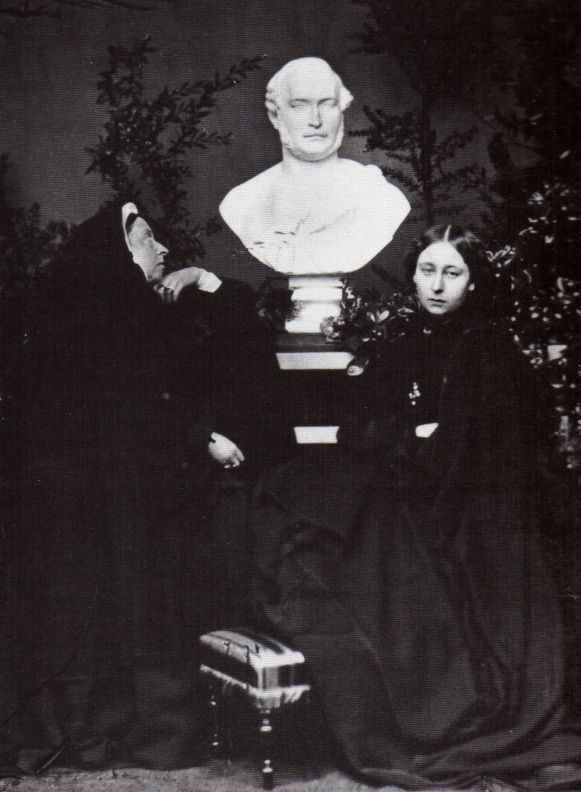
Mourning etiquette was hugely influenced by Queen Victoria during this period, her standards spreading into the grieving habits overseas, including North America and Australia.
A WIDOW’S MOURNING PERIOD
A widow was considered in mourning for up to three years, with three different stages that were very clearly defined by society. Any deviation was perceived as a slight to the dead, and society itself. Controlling through shame a rather typical Victorian approach.
Each stage had both clothing and behaviour expectations for bereaved wives.
Stage 1: Full Mourning – 1 year and 1 day
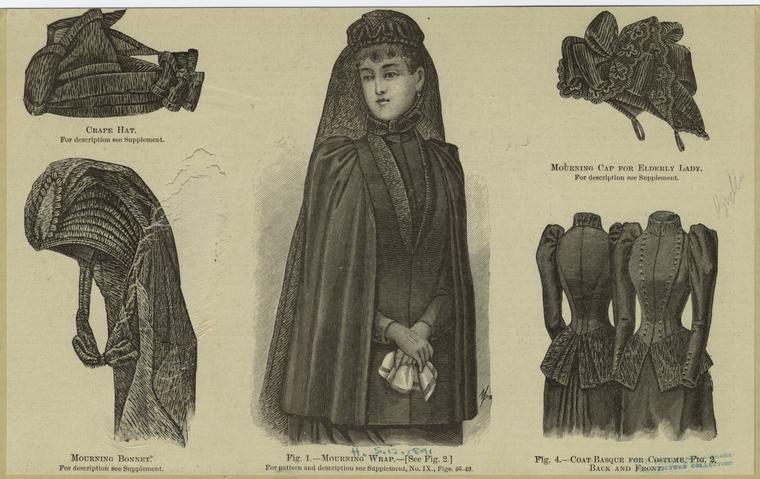
- All clothing was to be made from heavy black-based fabrics. These had to be plain with no ornamentation and made in a fabric that was flat and unreflective such as crape (pretty much a mourning-specific fabric), matt silks and bombazine.
- Jet jewellery was the only jewellery that could be worn.
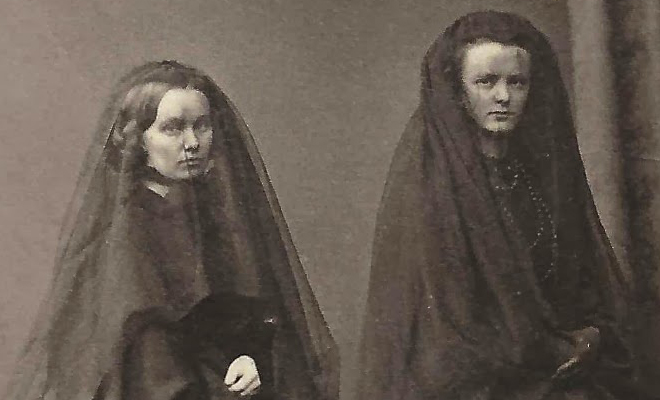
- A long veil, or Widows Weeds, had to be worn outside of the home.
- Withdrawal from society was expected for the duration of Full Mourning, although younger widows were given a little leeway on this.
Stage 2: Second Mourning – three-six months
This was the stage at which widows were able to return to society, with a change to their clothing to reflect the ‘alleviation’ of grief.
- Muted colours (or variations on ash tones) could return to the wardrobe – secondary mourning colours included grey, lavender, mauve with the occasional flash of white on collars or gloves.
- Fabrics with lustre could be introduced, as well as minor ornamentation and trim.
- The Widows Weed veil was no longer needed.
- Jewellery could include gold and precious stones, but still needed to be in combination with jet.
Stage 3: Half-quarter mourning, or ‘ordinary’ mourning – unlimited
This stage began the return to the new normal, where symbols of mourning could remain for as long as the wearer wanted to wear them. In general, though, black crape was finally out and embroidery and lace could return.
WIDOWERS
Men were expected to observe six months Full Mourning on the death of their wife. That doesn’t mean that men didn’t observe their grief through their clothing or behaviour for longer, it was just that society’s expectation was that they’d move on quickly. They had Very Important Work and Heirs to make, after all.
MOURNING WAREHOUSES
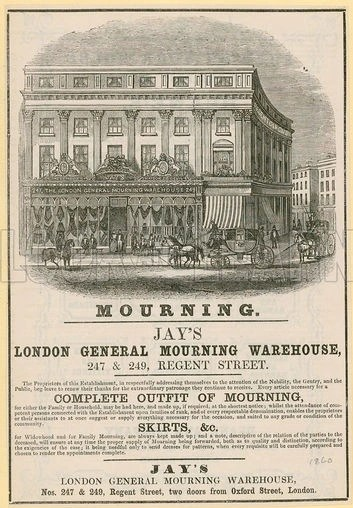
As mourning clothes were considered bad luck to keep in the home outside of a mourning period, anyone entering mourning would need new duds, and quickly. This led to a roaring trade in mourning clothes. Perhaps the biggest name in this market was Jay’s of Regent Street which opened in 1841. Part of the burgeoning ready-to-wear movement a family could visit the store to purchase packages – Household Mourning – for all the family, as well as gowns, hats, accessories and fabrics. Jay’s also sent dressmakers and milliners out to dress or style the bereaved in the comfort of their own home.
FURTHER PERIODS OF MOURNING
Widows bore the brunt of the most extended and restrictive expectations, but most deaths of loved ones demanded a period of mourning:
- Parent/Child – 1 year
- Grandparent/Sibling – six months
- Aunt/Uncle – two months
- Great Uncle/Aunt – six weeks
- First Cousins – four weeks
With thanks to the following blogs: